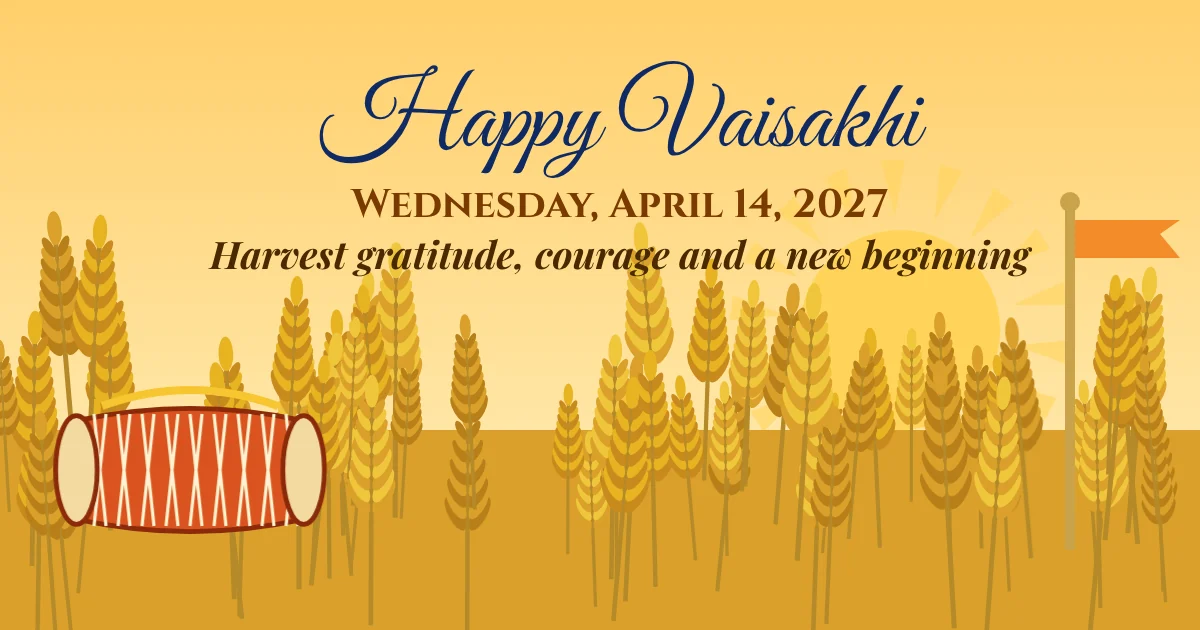
Quick answer: Vaisakhi (also spelled Baisakhi) in 2027 falls on Wednesday, April 14. It is a spring harvest festival in Punjab, the start of the solar new year for many communities, and for Sikhs it is the day that marks the founding of the Khalsa in 1699. A common greeting is “Happy Vaisakhi” or, in Punjabi, “Vaisakhi diyan vadhaiyan” (congratulations on Vaisakhi). At the gurdwara you may also hear “Waheguru Ji Ka Khalsa, Waheguru Ji Ki Fateh.”
Vaisakhi is one of those festivals that carries several meanings at once. In the fields of Punjab it is a moment of gratitude, when the winter wheat turns gold and is ready to cut. In the gurdwara it is a solemn and joyful anniversary of the day the Khalsa was created. And in streets from Amritsar to Toronto to Southall it is a day of processions, hymns, drums, dancing and free meals for everyone. This guide explains what Vaisakhi is, how it is celebrated, how to greet people respectfully, and gives you 40 original wishes to share.
On this page
- When is Vaisakhi 2027?
- What is Vaisakhi?
- The story of the Khalsa
- How Vaisakhi is celebrated
- How to say Happy Vaisakhi
- 40 Vaisakhi wishes and messages
- Vaisakhi cards and GIFs
- Vaisakhi foods
- Visiting a gurdwara: simple etiquette
- Vaisakhi and other new year festivals in April
- Frequently asked questions
- Sources
When is Vaisakhi 2027?
Vaisakhi follows the solar calendar and falls on the first day of the month of Vaisakh, which means it lands on April 13 or 14 almost every year. In 2027 it is Wednesday, April 14. The sun’s entry into Aries (the Mesha Sankranti) is listed for 3:33 PM IST that day, and 2027 marks the 328th anniversary of the founding of the Khalsa.
| Date | What to expect |
|---|---|
| Saturday, April 10 | Some communities hold melas and processions on the weekend before |
| Wednesday, April 14 | Vaisakhi: gurdwara services, Akhand Path completions and the main celebrations |
| Saturday, April 17 | Many cities hold their Nagar Kirtan parade on the weekend after |
What is Vaisakhi?
Vaisakhi began as a harvest festival in the Punjab region. It celebrates the rabi harvest, the crops that are sown in winter and ripen in spring, and for farming families it is a time to give thanks for a full granary and to pray for a good season ahead. It also marks the solar new year for many communities who follow the solar calendar.
For Sikhs, Vaisakhi took on an additional and deeper meaning in 1699, when the tenth Guru, Guru Gobind Singh, founded the Khalsa on this day at Anandpur Sahib. That is why the day is among the most important in the Sikh year, and why it is sometimes called Khalsa Sajna Diwas, the day the Khalsa was created.
The story of the Khalsa
According to Sikh tradition, in 1699 a large gathering of Sikhs had come to Anandpur to celebrate the harvest festival. At the height of the gathering, Guru Gobind Singh emerged from a tent carrying a drawn sword and asked whether anyone was prepared to give their life for their faith. Five volunteers stepped forward one at a time. They became the Panj Pyare, the “five beloved ones,” and were the first to be initiated into the Khalsa. The Guru then asked the five to initiate him in turn.
The word Khalsa means “the pure.” It is a community of initiated Sikhs that is casteless and open to women and men, and it stands for courage, equality and service. Initiated Sikhs take the surname Singh (lion) for men and Kaur (princess) for women, and wear the five Ks as part of their identity: kesh (uncut hair), kara (a steel bracelet), kangha (a comb), kirpan (a ceremonial sword) and kachera (a particular undergarment). Not all Sikhs are initiated; many choose to join when they feel ready.

How Vaisakhi is celebrated
- Gurdwara services. Families visit the gurdwara in the morning for prayers and kirtan (hymn singing). Many gurdwaras complete an Akhand Path, a continuous reading of the Guru Granth Sahib that takes about 48 hours, timed to finish around Vaisakhi.
- Nishan Sahib. The saffron flag outside the gurdwara is taken down, the flagpole is washed with water and milk, and a fresh cloth is raised.
- Nagar Kirtan. This is a public procession whose name means “town hymn-singing.” Five Sikhs representing the Panj Pyare lead it, the Guru Granth Sahib is carried on a decorated float, and there is singing, drumming, gatka (a martial art) and free food for everyone along the route. Neighbors of every background are welcome.
- Langar. Every gurdwara serves langar, a free vegetarian meal for all, eaten sitting side by side. On Vaisakhi it is often served on a very large scale.
- Amrit ceremonies. Many gurdwaras hold the initiation into the Khalsa in memory of 1699.
- Melas, bhangra and giddha. Community fairs bring folk dancing, music, sweets and stalls. People often wear yellow, orange or blue.
- Harvest thanks. In rural Punjab, farmers give thanks for the wheat harvest, and some villages hold traditional harvest gatherings with drums and folk songs.

How to say Happy Vaisakhi
- Happy Vaisakhi (pronounced vy-SAH-kee): perfectly fine in English. You will also see it spelled Baisakhi (by-SAH-kee).
- Vaisakhi diyan vadhaiyan: a Punjabi greeting meaning “congratulations on Vaisakhi.”
- Waheguru Ji Ka Khalsa, Waheguru Ji Ki Fateh: the Sikh greeting. It is best used by people who know the friend or community well, or who are comfortable with the phrase.
40 Vaisakhi wishes and messages
All of these messages are original. Use them in cards, texts, social posts and family group chats.
Classic Vaisakhi greetings
- Happy Vaisakhi! May your year be as golden as a wheat field at harvest.
- Vaisakhi diyan vadhaiyan to you and your family.
- Wishing you a joyful Vaisakhi full of music, family and good food.
- May the spirit of Vaisakhi fill your home with happiness and your heart with gratitude.
- Happy Baisakhi! May this new year bring you health, peace and plenty.
- Sending warm Vaisakhi wishes to you and everyone you love.
- May Vaisakhi bring new hope, new beginnings and many reasons to celebrate.
- Wishing you a blessed and joyful Vaisakhi.
Harvest and gratitude wishes
- May your fields, your work and your table all be full this year.
- Thankful for the harvest, the hands that grew it and the families that share it. Happy Vaisakhi.
- To every farmer: thank you for feeding us. Wishing you a bountiful season ahead.
- May the gold of the wheat remind you how much good has grown in your life.
- Gratitude is the best harvest. Happy Vaisakhi.
- May the new season bring you steady rain, warm sun and good yields.
- Here is to hard work that is finally ripe. Happy Baisakhi!
- May every seed you planted this year bloom into something wonderful.
Family and friends
- To my family: may we always dance together, eat together and celebrate together.
- Dear friend, I hope your Vaisakhi is full of laughter and a little bhangra.
- Thank you for being the kind of neighbor who always shares the food. Happy Vaisakhi!
- To my parents and grandparents: your stories make every festival richer.
- May our family table always have room for one more.
- Sending hugs across the miles. Wishing you a very happy Vaisakhi.
- May this day bring all of us a little closer.
- Cheers to friends who turn every festival into a memory.

Spiritual and reflective wishes
- May we live with courage, serve with humility and treat everyone as equal.
- On this day of the Khalsa, may we find the strength to stand up for what is right.
- May seva, the joy of serving others, be at the heart of your Vaisakhi.
- Wishing you peace, blessings and the courage to begin again.
- May the langar table remind us that no one should eat alone.
- May we carry the spirit of equality into everything we do.
- Wishing you a year of faith, kindness and quiet strength.
- May every new year bring us closer to who we hope to be.

Short captions and texts
- Happy Vaisakhi!
- Vaisakhi diyan vadhaiyan!
- Dhol up, spirits high. Happy Baisakhi!
- Golden fields, grateful hearts.
- Wishing you a bright new year.
- Courage, equality, service. Happy Vaisakhi.
- Eat well, dance well, give well.
Vaisakhi cards and GIFs
Here are animated greetings and a phone wallpaper to send alongside your wishes.

Phone wallpaper

Vaisakhi foods
- Kada prasad. A warm sweet offering made of semolina, ghee and sugar, handed out after prayers at the gurdwara.
- Langar. A free vegetarian meal, often including dal, vegetables, flatbread and rice, served to everyone who visits.
- Home feasts. Families often gather for a festive meal in the evening. Popular Punjabi dishes include sarson da saag with makki di roti, chole, lassi and sweets such as kheer.
- Street food at melas. Fairs often have stalls with jalebi, pakoras and other snacks.
Visiting a gurdwara: simple etiquette
Everyone is welcome at a gurdwara, including on Vaisakhi. A few simple courtesies help visitors feel at ease:
- Cover your head. Scarves are usually available at the entrance.
- Take off your shoes and wash your hands before entering.
- Sit on the floor. Try not to point your feet toward the Guru Granth Sahib.
- Do not bring or wear tobacco, alcohol or meat into the gurdwara.
- Accept the langar and the prasad. Eating together is the point, and there is no charge.
Vaisakhi and other new year festivals in April
Vaisakhi coincides with several regional new year and harvest festivals that follow the solar calendar. Around the same time in mid-April, Bengali communities mark Pohela Boishakh, Kerala marks Vishu, and Assam celebrates Bihu. If you also enjoy harvest celebrations earlier in the year, see our guide to Lohri and Pongal wishes and traditions.
Baisakhi is also remembered for a tragic event: on April 13, 1919, British troops fired on a Baisakhi gathering at Jallianwala Bagh in Amritsar. An official British report estimated 379 deaths and about 1,200 wounded, though Indian sources suggest the toll was much higher. Many people take a moment to remember the victims alongside the festival.
Frequently asked questions
When is Vaisakhi in 2027?
Vaisakhi 2027 is on Wednesday, April 14. Many cities hold parades and fairs on the nearest weekend, such as April 10 or April 17.
What is the difference between Vaisakhi and Baisakhi?
They are two spellings of the same festival. Both refer to the first day of the month of Vaisakh.
Why is Vaisakhi important to Sikhs?
It marks the day in 1699 when Guru Gobind Singh founded the Khalsa, the community of initiated Sikhs, at Anandpur Sahib.
What is a Nagar Kirtan?
It is a public procession with hymn singing, led by five Sikhs representing the Panj Pyare and carrying the Guru Granth Sahib on a decorated float. Everyone is welcome to watch.
What do you say on Vaisakhi?
“Happy Vaisakhi” works in English. In Punjabi people say “Vaisakhi diyan vadhaiyan,” and Sikhs also use the greeting “Waheguru Ji Ka Khalsa, Waheguru Ji Ki Fateh.”
Is Vaisakhi only a Sikh festival?
No. It began as a harvest festival in Punjab and is still celebrated by people of various faiths and backgrounds across South Asia, in addition to its special meaning for Sikhs.
A closing thought
Vaisakhi brings together gratitude for the harvest, the courage of the Khalsa and the simple joy of sharing a meal and a dance. However you mark it, in a gurdwara, on a street parade or at a family table, we hope it brings you a bright new beginning. Happy Vaisakhi.