Kwanzaa is a week-long cultural celebration that begins on December 26 and ends on January 1. Each day is built around one of seven guiding values, the Nguzo Saba, and a family lights one candle on a kinara to mark it. In 2026 it begins on a Saturday, so the first night is easy to plan around. Maulana Karenga created the holiday in 1966, and it is observed by many African American families in the United States and by communities around the world. This page explains the seven principles, the symbols, the candle order, ideas for each day, kids’ activities, greetings, captions and tips for people who want to greet friends respectfully.
On this page: Daily chart for 2026 · The seven principles explained · Candle order · Quotes and reflections · Activities for kids · Greetings · Captions · The seven symbols · Ideas for each day · Karamu feast · Zawadi gifts · Greeting respectfully
Kwanzaa 2026 Daily Chart
| Date | Principle | Meaning | Candle |
|---|---|---|---|
| Saturday, Dec 26 | Umoja | Unity | Black (center) |
| Sunday, Dec 27 | Kujichagulia | Self-determination | Red (left) |
| Monday, Dec 28 | Ujima | Collective work and responsibility | Green (right) |
| Tuesday, Dec 29 | Ujamaa | Cooperative economics | Red |
| Wednesday, Dec 30 | Nia | Purpose | Green |
| Thursday, Dec 31 | Kuumba | Creativity | Red (Karamu feast is held this evening) |
| Friday, Jan 1 | Imani | Faith | Green |
For general Kwanzaa greetings and wishes, see our main Kwanzaa wishes, greetings and quotes post. This page goes deeper into the principles.
The Seven Principles Explained
Day 1, December 26: Umoja (Unity)
Meaning: to strive for and maintain unity in the family, community, nation and race.
Reflection question: How can I help bring my family and neighbors closer?
- Together we are stronger.
- Unity begins at our own table.
- Happy Umoja! May our circle grow wider this year.
Day 2, December 27: Kujichagulia (Self-Determination)
Meaning: to define ourselves, name ourselves, create for ourselves and speak for ourselves.
Reflection question: What do I want my story to say?
- Define yourself before the world does.
- Your voice is your own. Use it well.
- Happy Kujichagulia! Stand in who you are.
Day 3, December 28: Ujima (Collective Work and Responsibility)
Meaning: to build and maintain our community together and to make our sisters’ and brothers’ problems our problems, and solve them together.
Reflection question: Who in my community could use my help this week?
- When we lift each other, no one has to climb alone.
- Many hands make a stronger community.
- Happy Ujima! Let’s get to work, together.
Day 4, December 29: Ujamaa (Cooperative Economics)
Meaning: to build and maintain our own stores, shops and other businesses and to profit from them together.
Reflection question: How can I support Black-owned businesses in my area?
- Spend where it strengthens the community.
- Every purchase is a small vote for the world you want.
- Happy Ujamaa! Shop local, build together.
Day 5, December 30: Nia (Purpose)
Meaning: to make our collective vocation the building and developing of our community in order to restore our people to their traditional greatness.
Reflection question: What is my purpose, and how does it serve others?
- Purpose turns effort into legacy.
- Know your why, and the how follows.
- Happy Nia! May your purpose be clear and your steps steady.
Day 6, December 31: Kuumba (Creativity)
Meaning: to do always as much as we can, in the way we can, in order to leave our community more beautiful and beneficial than we inherited it.
Reflection question: What can I create or improve this year?
- Create something beautiful today.
- Creativity is how we leave things better than we found them.
- Happy Kuumba! Make, build, paint, write, sing.
Kuumba is also the day of the Karamu feast, a large celebration with food, music and storytelling. It falls on New Year’s Eve, so you may also like our New Year’s Eve wishes.
Day 7, January 1: Imani (Faith)
Meaning: to believe with all our heart in our people, our parents, our teachers, our leaders and the righteousness and victory of our struggle.
Reflection question: What do I believe in strongly enough to act on?
- Believe in your people, your purpose and your future.
- Faith turns a hope into a plan.
- Happy Imani! Start the year trusting what you’ve built.
Imani falls on New Year’s Day, so it pairs naturally with New Year’s Day wishes.
How the Kinara Is Lit
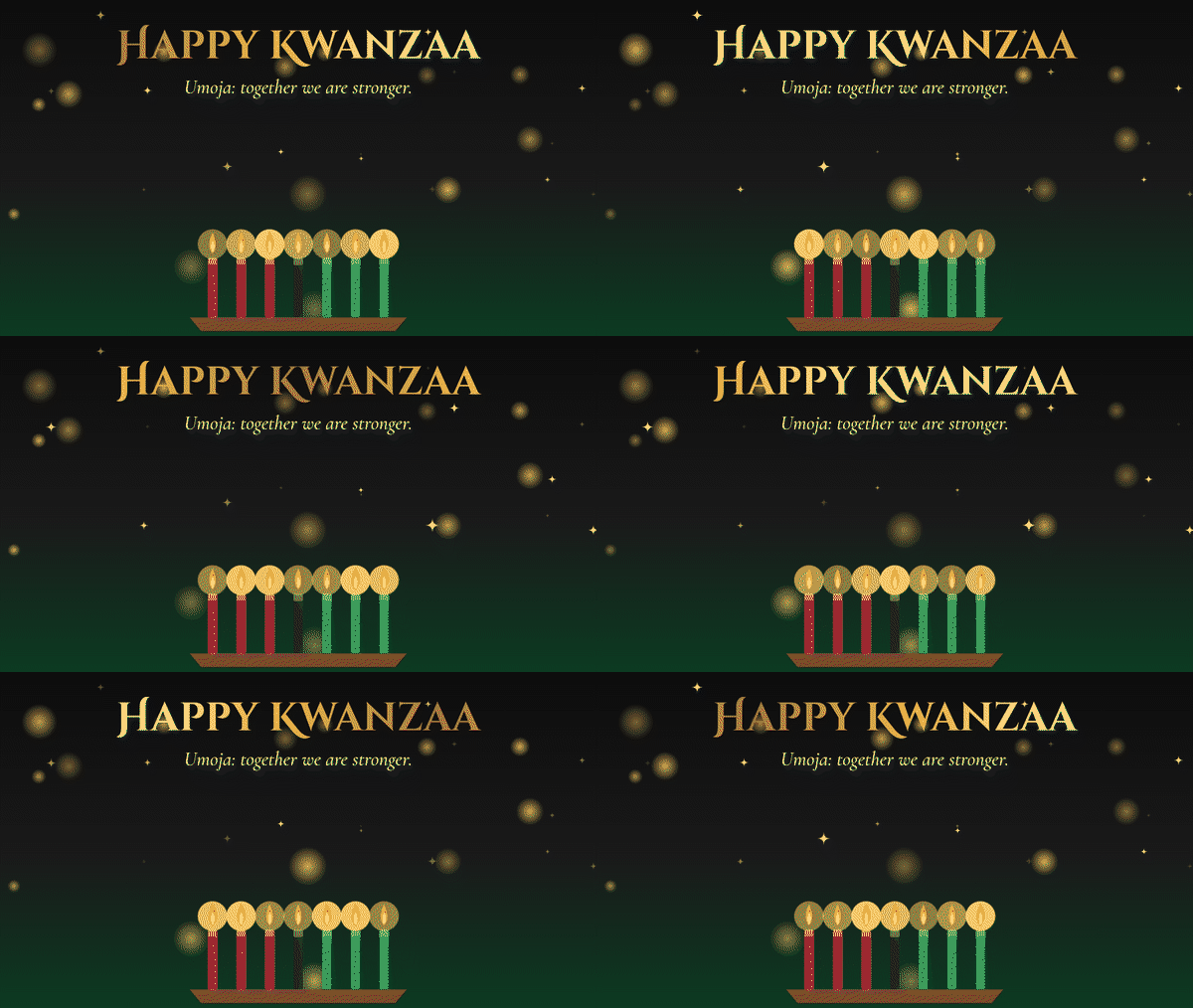
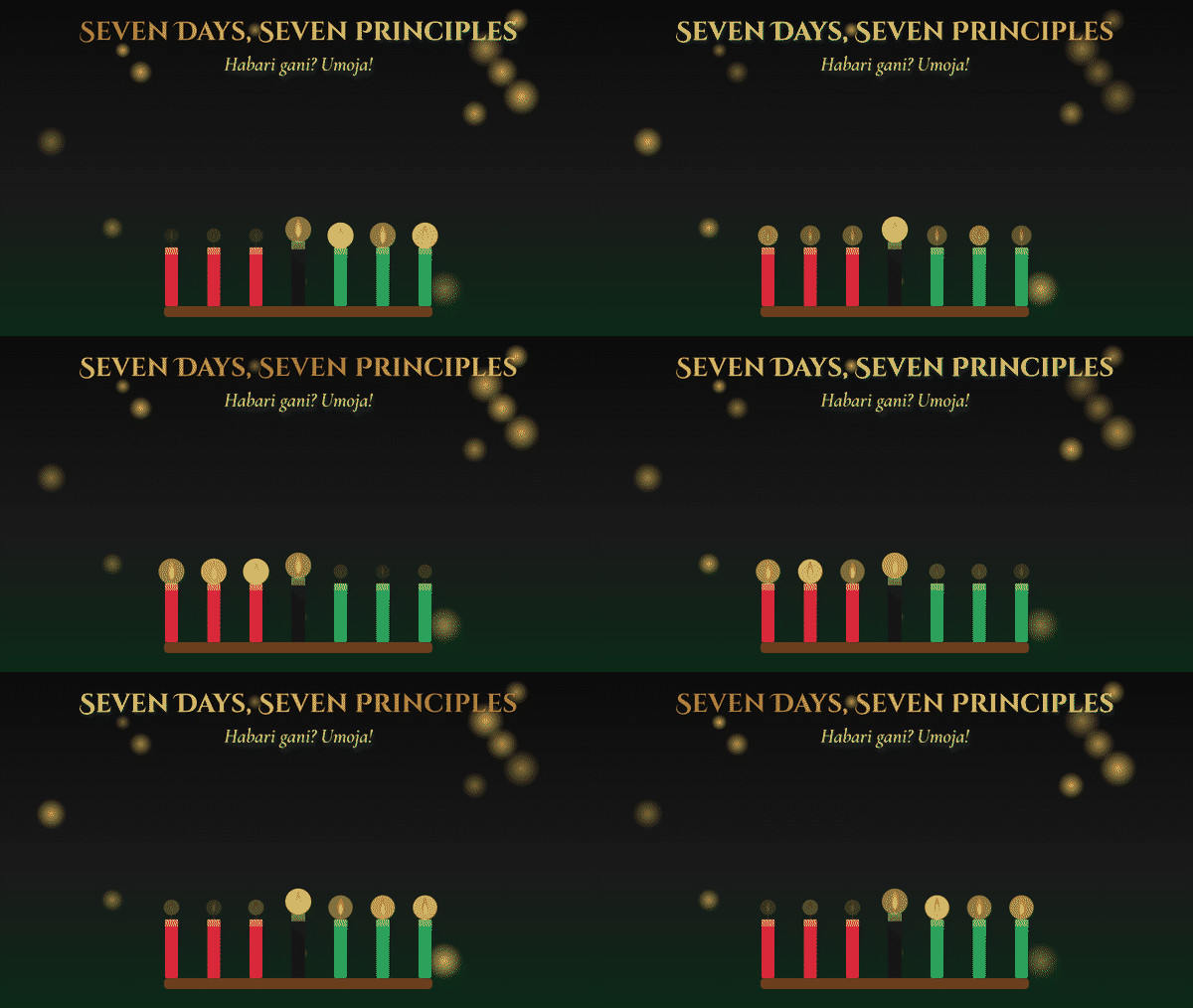
- The kinara holds seven candles (mishumaa saba): one black in the center, three red on the left and three green on the right.
- Day 1: light the black candle (Umoja).
- Day 2: light the red candle on the far left (Kujichagulia).
- Day 3: light the green candle on the far right (Ujima).
- Continue alternating between the left and right sides, moving toward the center, until all seven are lit on January 1.
The black candle stands for the people, red for their struggle and green for the future and the hope that comes from it. Other symbols include the mkeka (mat), mazao (crops), muhindi (ears of corn), kikombe cha umoja (unity cup) and zawadi (gifts).
21 Quotes and Reflections for the Week
These are original lines you can use on cards and in posts.
- A family is a small community. A community is a large family.
- Unity doesn’t mean we’re the same. It means we’re in this together.
- We don’t inherit a better world. We build one, with help.
- Self-definition is the first act of freedom.
- Say your own name with pride.
- The strongest communities share the work and the credit.
- A problem shared is a problem halved.
- Ownership begins with a decision to build.
- Cooperation is wealth that never runs out.
- Purpose is the compass that makes every step count.
- Be able to say what you’re here to do.
- Beauty is a form of leadership.
- Art is how a community remembers itself.
- Leave things a little better than you found them.
- Faith is the courage to plan for what you can’t yet see.
- Believe in your people, then show up for them.
- Seven days, seven principles, a lifetime of practice.
- Culture is a gift passed from one generation to the next.
- Gather, give thanks and begin again.
- Every principle is a promise to one another.
- Heri za Kwanzaa! Let’s keep the principles all year.
Simple Activities for Children
- Make a mkeka: weave strips of red, black and green paper into a mat.
- Draw a kinara: color seven candles and label each with its principle.
- Daily question: ask “Habari gani?” and let children answer with the day’s principle.
- Unity cup toast: pass a cup and have each family member say one thing they’re grateful for.
- Creative day: on Kuumba, make a card, a drawing or a song for someone special.
- Give a small gift (zawadi): homemade or educational gifts are traditional.
Kwanzaa Greetings
- “Habari gani?” means “What’s the news?” and is the daily greeting. The reply is the day’s principle, such as “Umoja!”
- “Heri za Kwanzaa” means “Happy Kwanzaa.”
- “Kwanzaa yenu iwe na heri” means “May your Kwanzaa be happy.”
Planning a December greeting for a mixed group? See Happy Holidays messages. If you also celebrate Hanukkah, see Hanukkah captions.
15 Kwanzaa Captions
- Habari gani? Umoja! 🕯️
- One candle at a time.
- Seven days, seven principles.
- Red, black and green, always.
- Celebrating culture, community and family.
- Karamu night, full table, full heart.
- Creating something beautiful for Kuumba.
- Heri za Kwanzaa, family!
- Faith in our people, today and always.
- Lighting the kinara with the ones I love.
- Principles to live by, all year long.
- Supporting Black-owned businesses for Ujamaa.
- Unity is the first step.
- Passing down traditions.
- Happy Kwanzaa to all who celebrate.
The seven symbols of Kwanzaa
Alongside the seven principles, Kwanzaa has seven symbols, which are usually arranged on a table together. Their Swahili names are widely used, and each has a simple meaning.
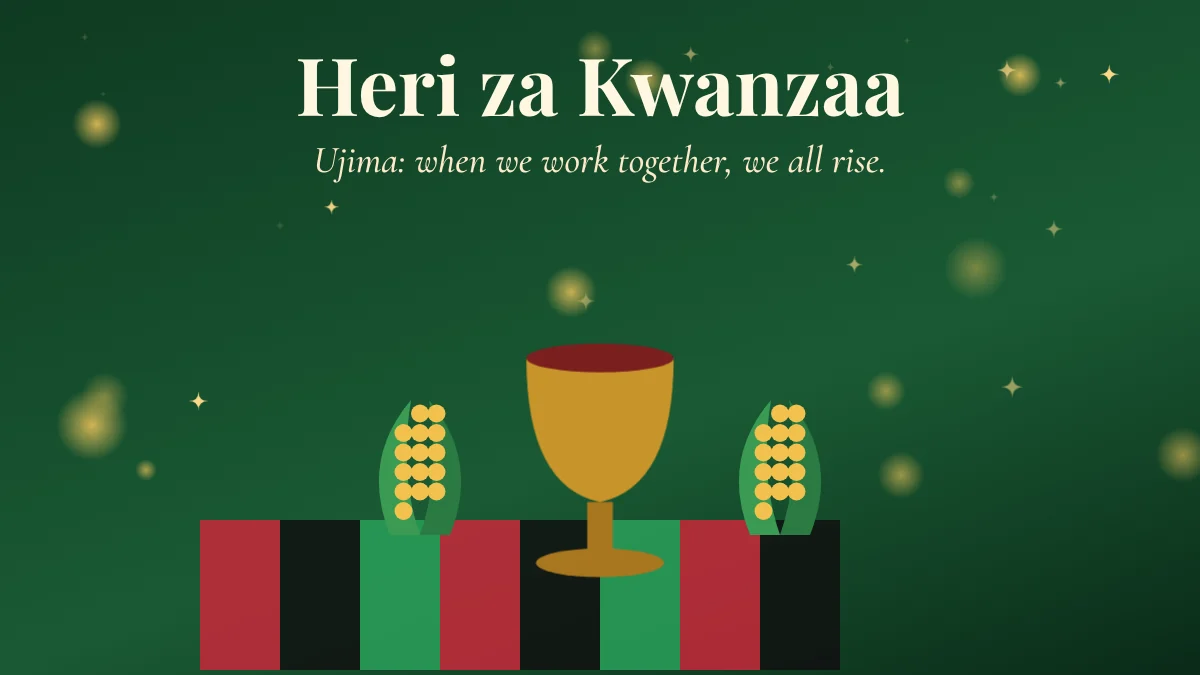
- Mazao (the crops): Fruits and vegetables that represent the harvest and the rewards of collective labor.
- Mkeka (the mat): A woven mat that serves as the foundation on which the other symbols rest, representing tradition and history.
- Kinara (the candle holder): It holds the seven candles and stands for the ancestors and roots of the community.
- Muhindi (the corn): One ear for each child in the family, representing children and the future. A family without children may still display at least one ear.
- Mishumaa Saba (the seven candles): Three red, three green and one black candle, standing for the principles.
- Kikombe cha Umoja (the unity cup): A shared cup used to pour a libation and drink in honor of unity and ancestors.
- Zawadi (the gifts): Meaningful, often handmade or educational presents, especially for children.
A flag called the Bendera, in black, red and green, is also commonly displayed. Black stands for the people, red for their struggle, and green for the future and the land.
One idea for each day of Kwanzaa
The principles are best understood by doing something with them. Here are two ideas for each day, one for the family and one for the wider community. They are suggestions, not rules, so adapt freely.
- Dec 26, Umoja (unity): Share a meal where everyone helps prepare something. Call a relative you have not spoken to in a while.
- Dec 27, Kujichagulia (self-determination): Have each family member write down a personal goal for the year and say it aloud. Support a local Black-owned business that defines its own path.
- Dec 28, Ujima (collective work and responsibility): Work together on a household project, such as cleaning or cooking. Volunteer for a neighborhood cleanup or food drive.
- Dec 29, Ujamaa (cooperative economics): Review the family budget together and talk about saving and giving. Buy from a local cooperative or neighborhood shop.
- Dec 30, Nia (purpose): Talk about what each person hopes to contribute in the year ahead. Mentor or encourage a young person.
- Dec 31, Kuumba (creativity): Make something, such as art, music, a poem or a craft, and share it at the feast. Support a local artist.
- Jan 1, Imani (faith): Reflect on trust in family, community and the future. Write a letter to a younger generation about your hopes.
The Karamu feast on December 31
Many families hold a Karamu, a communal feast, on December 31, the sixth night of Kwanzaa. It is usually the largest gathering of the week and often includes music, storytelling, dance, poetry and a shared meal. The feast follows the day of Kuumba, so creativity is on display, and it leads naturally into the final day, Imani.
A typical Karamu includes these elements.
- A welcome that explains the meaning of the evening.
- A reading or recitation of the principles.
- A libation poured from the unity cup in honor of ancestors, followed by shared drinking.
- A meal made up of dishes from African, Caribbean and Southern traditions, often prepared by many hands.
- Performances by children and adults, such as songs, drumming or poetry.
- A moment for each person to speak about what they are thankful for.
- A closing message of hope for the new year.
Because the Karamu falls on New Year’s Eve, some families blend it with their countdown. For New Year’s wishes to send alongside, see New Year’s Eve wishes and New Year’s Day 2027 wishes.
Zawadi: thoughtful Kwanzaa gifts
Gifts, or Zawadi, are traditionally meaningful rather than extravagant, with an emphasis on handmade and educational items. Here are fifteen ideas.
- A children’s book by an African American author.
- A handmade card or poem.
- A family tree poster you create together.
- A journal for writing goals or reflections.
- A piece of kente cloth or a scarf in the Kwanzaa colors.
- A small drum or musical instrument.
- A homemade jar of spice mix or preserves.
- A framed photograph of an elder.
- A board game that teaches history or math.
- Seeds and a small pot for a child to grow a plant.
- A museum membership or visit.
- A recording of a family story told by a grandparent.
- A donation to a community organization in someone’s name.
- A set of art supplies.
- A handwritten recipe book with family favorites.
Greeting friends during Kwanzaa respectfully
If you do not celebrate Kwanzaa but have friends, neighbors or coworkers who do, a few small habits go a long way.
- A simple “Happy Kwanzaa” is welcome. If you want to try Swahili, “Heri za Kwanzaa” means “Happy Kwanzaa.”
- The traditional question is “Habari gani?” which means “What’s the news?” The answer is the principle of the day.
- Kwanzaa is a cultural holiday, not a religious one, and many families also celebrate Christmas. Kwanzaa is not “the African American Christmas.”
- Do not assume that everyone who is Black celebrates it. Many do, and many do not, so ask or follow cues.
- Learn the dates. Sending a greeting on December 26 or any day through January 1 is best.
- Pair your wishes with kindness. A good coworker message might be, “Wishing you and your family a meaningful Kwanzaa.”
For a quick look at other end-of-December dates, including Boxing Day, see Boxing Day wishes and quotes. If you also want a reference for the wider holiday calendar, try our Happy Holidays messages. The longer, earlier Kwanzaa guide, Kwanzaa wishes, greetings and quotes, has more greetings to copy.
Explaining the seven principles to children
Children often grasp the principles more easily than adults expect when you use plain language and everyday examples. Here is a one-line explanation for each, plus a question to ask at dinner.
- Umoja (unity): We are stronger when we stay together. Ask: How did our family help each other today?
- Kujichagulia (self-determination): We decide who we are and speak for ourselves. Ask: What is something you are proud to be?
- Ujima (collective work and responsibility): We solve problems together. Ask: What job did you do that helped someone else?
- Ujamaa (cooperative economics): We share and support our community’s businesses. Ask: Which local shop do we love, and why?
- Nia (purpose): We have goals that make life meaningful. Ask: What would you like to learn or build this year?
- Kuumba (creativity): We make things that make the world more beautiful. Ask: What can you create today?
- Imani (faith): We believe in each other and in a better future. Ask: Who believes in you, and who do you believe in?
A simple ritual helps. Each evening, after lighting the candle, ask “Habari gani?” and let a child answer with the day’s principle, then share one example from their own day. It takes two minutes and makes the principles real.
A brief history of Kwanzaa
Kwanzaa was created in 1966 by Maulana Karenga, a professor and activist, in the aftermath of the Watts uprising in Los Angeles. He wanted to give African Americans a celebration that affirmed their heritage and community. The name comes from the Swahili phrase “matunda ya kwanza,” meaning “first fruits,” and the holiday draws on harvest festivals across Africa. Swahili was chosen as a pan-African language, not because all African Americans trace their ancestry to Swahili-speaking regions.
Since the late 1960s, Kwanzaa has grown into a widely recognized cultural holiday. It is observed in homes, schools, community centers and museums, and the seven principles are often cited in education and community work. It is not a religious holiday and is not meant to replace Christmas, so many families celebrate both. Like many traditions, it has its own history and debates, and people relate to it differently. Understanding that background helps you talk about it with respect.
Ten ways to celebrate Kwanzaa as a community
- Host a candle-lighting at a library or community center.
- Organize a Karamu feast with potluck dishes.
- Invite local artists to share work on Kuumba day.
- Run a children’s craft day with corn, mats and paper candles.
- Hold a storytelling night with elders.
- Create a market of local Black-owned businesses on the day of Ujamaa.
- Organize a neighborhood cleanup or food drive on Ujima.
- Arrange a school assembly or classroom lesson on the Nguzo Saba.
- Hold a drumming, dance or poetry performance.
- Invite neighbors who do not celebrate to attend and learn.
Many of these can double as ways to honor Dr. King’s legacy a few weeks later, and our MLK Day messages and quotes have ideas for that day of service.
Setting up your Kwanzaa table: a quick checklist
You can set up a Kwanzaa display in about fifteen minutes. The table does not need to be elaborate, and families often add their own touches over time.
- Spread the mkeka (mat) on a table or the floor.
- Place the kinara in the center of the mat.
- Arrange the seven candles in the kinara: three red on the left, three green on the right and the black one in the middle.
- Set the corn beside the kinara, one ear for each child.
- Add a bowl of fruit and vegetables for the mazao.
- Put the unity cup on the mat.
- Lay out the zawadi, or gifts, near the table.
- Hang or display the bendera nearby.
- Add a book, a photo of ancestors or a piece of local art.
- Choose a time each evening for lighting, and keep matches out of children’s reach.
Light the black candle first on December 26. Then, on each following night, light the black candle and then alternate between the red and green candles, beginning on the left. Take a moment to say the day’s principle aloud and invite each person to share a thought.
Conclusion
Use the daily chart to pick a principle, light a candle and share one reflection with your family. Heri za Kwanzaa!