Quick answer: Orthodox Easter, called Holy Pascha, falls on Sunday, May 2, 2027. Western Easter is on March 28, so the two celebrations are five weeks apart this year. Great Lent begins on March 15, Palm Sunday is April 25, and Holy Friday is April 30. The traditional greeting from Pascha night until the Ascension is “Christ is risen!” with the reply “Truly He is risen!”
For Orthodox Christians, Pascha is the Feast of Feasts, the center of the entire church year. It is also one of the most atmospheric celebrations anywhere: a dark church at midnight, a single flame passed from candle to candle, bells and fireworks, red eggs cracked at a table full of food after weeks of fasting. This guide covers the 2027 dates, why Orthodox Easter often falls on a different Sunday than Western Easter, the traditions of the Greek, Russian, Ukrainian and Serbian communities, and 40 original wishes you can send to family, friends and colleagues.
On this page
- Orthodox Easter 2027 dates
- Why the dates differ
- How to say “Christ is risen”
- Pascha traditions
- Foods of Pascha
- 40 Orthodox Easter wishes
- Cards, GIFs and wallpaper
- FAQ
Orthodox Easter 2027 dates
These are civil (Gregorian) dates for the traditional Orthodox Paschal calendar, as published by the Greek Orthodox Archdiocese of America. Some Orthodox churches use a different civil calendar for fixed feasts such as Christmas, but Pascha and the feasts that depend on it are counted together. Service times vary by parish, so check your local bulletin.
| Observance | Date in 2027 |
|---|---|
| Great Lent begins (Clean Monday) | Monday, March 15 |
| Lazarus Saturday | Saturday, April 24 |
| Palm Sunday | Sunday, April 25 |
| Holy Thursday | Thursday, April 29 |
| Holy Friday | Friday, April 30 |
| Holy Saturday | Saturday, May 1 |
| Holy Pascha (Orthodox Easter) | Sunday, May 2 |
| Bright Monday | Monday, May 3 |
| Ascension | Thursday, June 10 |
| Pentecost | Sunday, June 20 |
The midnight Resurrection service takes place on the night of Saturday, May 1, running into Sunday. In Greece, Good Friday, Easter Sunday and Easter Monday are public holidays. In the United States, Orthodox Easter is not a federal holiday, so many parishioners take time off or attend services in the late evening.
Why Orthodox and Western Easter often fall on different dates
Both traditions follow the rule set by the Council of Nicaea in 325: Easter is the Sunday after the first full moon of spring. The difference is the calendar. The Orthodox Church calculates Pascha using the older Julian calendar, which now runs 13 days behind the Gregorian calendar used in the West. Western Easter can fall anywhere from March 22 to April 25, while Pascha can fall between April 4 and May 8.
Orthodox Easter is never earlier than Western Easter. Sometimes they land on the same Sunday, as they will in 2028 and 2031, and sometimes they are one, four or five weeks apart. In 2027, the gap is five weeks: March 28 for the West, May 2 for the Orthodox Church.
| Year | Orthodox Pascha | Western Easter |
|---|---|---|
| 2027 | May 2 | March 28 |
| 2028 | April 16 | April 16 |
| 2029 | April 8 | April 1 |
| 2030 | April 28 | April 21 |
| 2031 | April 13 | April 13 |
How to say “Christ is risen”
On Pascha night and for forty days afterward, until the Ascension, Orthodox Christians greet each other with a Paschal greeting instead of “Happy Easter.” One person says “Christ is risen!” and the other answers “Truly He is risen!” Before Pascha, Greek speakers say “Kalo Pascha,” meaning “a good Pascha.”
| Language | “Christ is risen!” | “Truly He is risen!” |
|---|---|---|
| English | Christ is risen! | Truly He is risen! |
| Greek | Christos anesti! | Alithos anesti! |
| Church Slavonic (used in Russian and other Slavic churches) | Khristos voskrese! | Voistinu voskrese! |
Other languages have their own versions, and spelling in the Latin alphabet varies. If you are writing to a friend from a specific community, it is a lovely touch to use their language, but double-check the spelling with a native speaker or your parish.
Pascha traditions
Pascha is the end of a long journey. It is preceded by about twelve weeks of preparation that include the pre-Lenten Sundays, Great Lent and Holy Week, and many families keep a strict fast. When the feast arrives, the services are combined into one great celebration.
- The midnight service. Near midnight between Holy Saturday and Sunday, the church is dark. A priest emerges with a single lit candle, and the light is passed from person to person until the whole church glows. In Greek tradition he calls out “Defte lavete fos” (“Come, receive the light”), and many congregations process around the church before the first “Christ is risen” is sung at its doors.
- Bells and fireworks. In many places the resurrection is announced with church bells, and in Greece also with fireworks and noise.
- Carrying the light home. Many Greeks try to carry the lit candle home and make a cross with its smoke over the door. A candle that stays lit all the way home is said to promise a good year.
- Red eggs. Eggs are dyed red, a symbol of the blood of Christ and of new life. After the service, family members crack them against each other, and the person whose egg survives is said to have good luck.
- Breaking the fast. The long fast ends with a feast. In Greek homes, the first meal is often magiritsa soup, followed on Sunday by roast lamb.
- Blessing of baskets. In Ukrainian, Serbian, Russian and other Slavic communities, baskets of food are brought to church to be blessed, then shared at home.
- Bright Week. The week after Pascha is kept without fasting, with services, visits and greetings.
Foods of Pascha
Food varies widely by country and by family, but these dishes are among the most recognized:
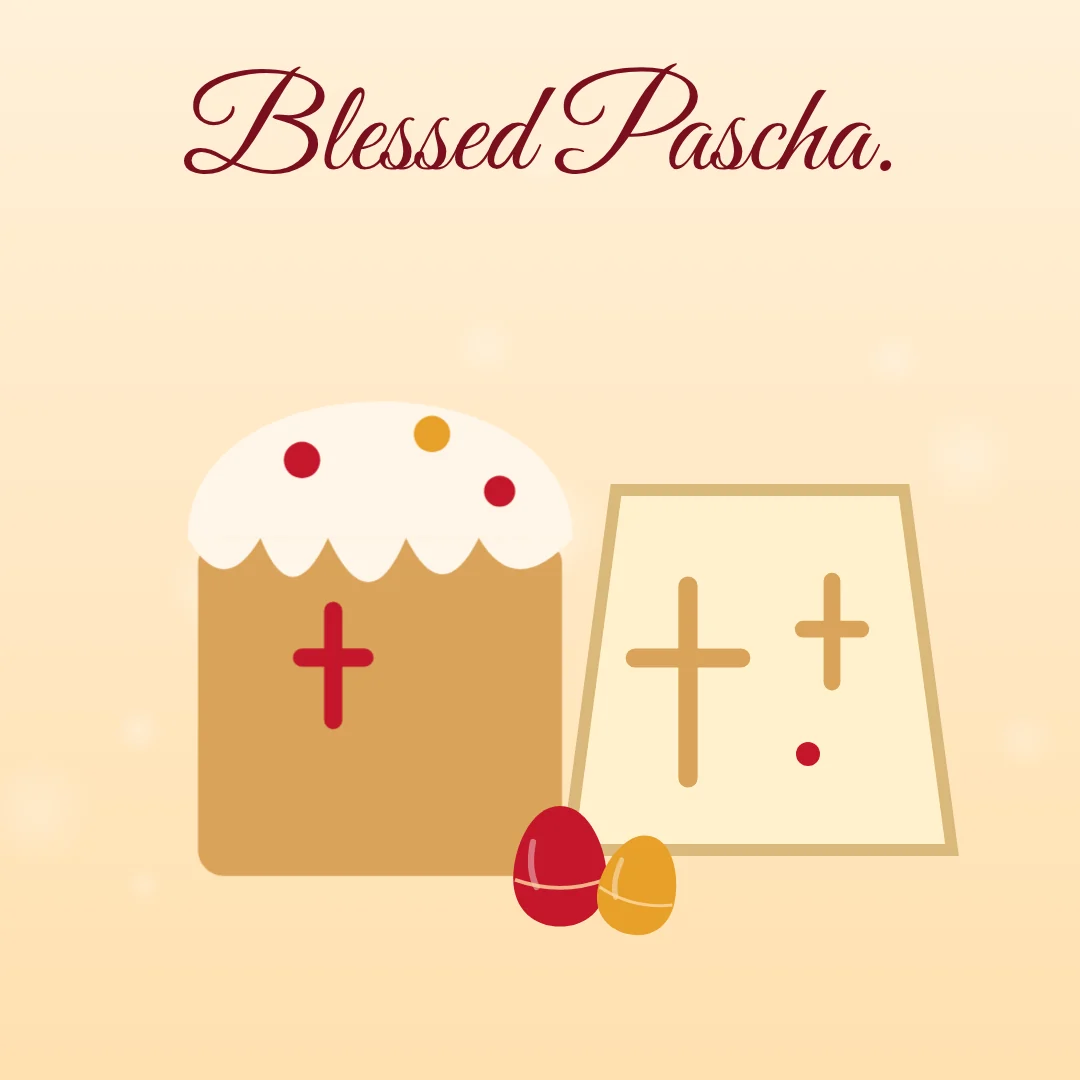
- Tsoureki. A sweet braided Greek Easter bread, often baked on Holy Thursday, with a red egg baked into the loaf.
- Magiritsa. A traditional Greek soup eaten after the midnight service.
- Roast lamb. The centerpiece of many Greek Easter Sundays, often turned on a spit.
- Kulich. A tall, sweet yeasted bread with white icing, common in Russian homes.
- Paska (paskha). In Russian tradition, a sweet cheese dessert shaped like a pyramid. In Ukrainian and other Slavic homes, “paska” is a rich bread.
- Blessed baskets. Eggs, bread, cheese, meats and other foods, covered with an embroidered cloth and blessed at church.

40 Orthodox Easter wishes and messages
These messages are original. Use them as they are or adjust the wording to fit your own voice and community.
Short wishes for texts
- Christ is risen! Truly He is risen! Happy Pascha.
- Kalo Pascha to you and your family.
- Wishing you a blessed and joyful Pascha.
- May the light of the Resurrection fill your home.
- Happy Orthodox Easter! May your table be full and your heart even fuller.
- Sending you peace, joy and a very red egg. Happy Pascha!
- Wishing you a bright and blessed Bright Week.
Wishes for family
- May our family gather around the table in good health and gladness this Pascha.
- To my parents and grandparents, thank you for teaching me what this night means. Christ is risen!
- May the joy of this feast stay with us long after the last candle has burned down.
- Wishing everyone at our table forgiveness, gratitude and a generous second helping.
- May the fast we kept be rewarded with laughter and love at the feast.
- Wherever you celebrate, know that our family is together in spirit. Happy Pascha.
Wishes for friends
- Happy Pascha, my friend! I hope your egg wins every round.
- May this season bring you rest after the long fast and joy after the long night.
- Thinking of you at midnight when the church lights up. Christ is risen!
- Wishing you good food, good company and plenty of bells.
- May your Pascha be as bright as a candle in the dark.
- Thank you for being a friend who shares the light. Kalo Pascha!
Spiritual and reflective messages
- May the light of the Resurrection scatter every darkness in your life.
- Let us forgive one another on this day of resurrection and embrace as friends.
- May hope rise in you this Pascha as surely as the sun rises after the longest night.
- May the joy of Christ’s resurrection fill your heart and overflow to everyone you meet.
- Christ is risen, and life is stronger than death. Wishing you a blessed feast.
- May this holy night renew your faith, steady your hope and widen your love.
Messages for colleagues and neighbors
- Wishing you and your family a peaceful and joyful Orthodox Easter.
- Warm wishes to you and your loved ones for a blessed Pascha.
- Happy Orthodox Easter to our colleagues celebrating this weekend. Enjoy the time with family.
- Best wishes for a Pascha full of health, happiness and hope.
Wishes for children and godchildren
- Happy Pascha, my dear godchild! May you grow in faith, kindness and joy.
- May you win the egg-cracking game and share your sweets with everyone.
- Wishing you a bright Easter full of candles, songs and family hugs.
- May your heart always be as light as a candle on Pascha night.
- Christ is risen! Have a wonderful and blessed Bright Week.
Cards, GIFs and wallpaper
Save and share any of these. The GIFs work well in family chats and status updates, and the wallpaper fits a phone screen.


Related guides
See our guides to Palm Sunday, Ash Wednesday, Orthodox Christmas and Passover.
Orthodox Easter FAQ
When is Orthodox Easter in 2027?
Orthodox Easter, or Holy Pascha, is on Sunday, May 2, 2027. The midnight Resurrection service takes place on the night of Saturday, May 1.
Why is Orthodox Easter later than Western Easter in 2027?
The Orthodox Church uses the Julian calendar to calculate Pascha, which runs 13 days behind the Gregorian calendar. In 2027, Western Easter is March 28 and Orthodox Easter is May 2, five weeks later.
What do you say on Orthodox Easter?
The traditional greeting is “Christ is risen!” with the reply “Truly He is risen!” In Greek, that is “Christos anesti!” and “Alithos anesti!” Before Pascha, Greeks say “Kalo Pascha.”
Why are Easter eggs red?
Red eggs are a symbol of the blood of Christ and of new life. After the service, family members crack them against each other in a friendly game.
Do Orthodox and Western Easter ever fall on the same day?
Yes. They coincide in some years, including 2028 (April 16) and 2031 (April 13). In other years Orthodox Easter comes one to five weeks later.
A closing thought
Pascha is about light that arrives after the longest dark, and about sharing it with the person next to you. Whether you stand with a candle in a crowded church, crack a red egg at a family table or send a short message to a friend far away, the greeting is the same. Christ is risen! Truly He is risen!
Sources
- Greek Orthodox Archdiocese of America: Paschalion
- Greek Orthodox Archdiocese of America: Dating Pascha in the Orthodox Church
- Athon: Orthodox Easter 2027
- Lives of the Saints Calendar: Orthodox Easter 2027
- Classical Academic Press: What Is Pascha?
- OrthodoxWiki: Pascha
- PublicHolidays.gr: Orthodox Easter
- Greece Insiders: When Is Orthodox Easter 2027?