Quick answer: Old New Year, also called Orthodox New Year, is the first day of the year on the old Julian calendar. It falls on January 14 in the Gregorian calendar, which in 2027 is a Thursday. Celebrations start on the evening of January 13. It is an informal, family-centered holiday, not a replacement for January 1, so most people celebrate both.
If your friends in Serbia, Ukraine, Russia, Belarus or North Macedonia seem to start the new year twice, they are not confused. They are keeping a tradition that is more than a century old, and it is a lovely excuse for a second round of good wishes just when the first round of resolutions is wearing thin. This guide explains where Old New Year comes from, how people mark it in different places, and gives you original messages, short toasts, free cards, GIFs and a phone wallpaper to share.
On this page
- What is Old New Year?
- Why January 14? The Julian calendar explained
- Where it is celebrated
- Old New Year 2027 dates
- Traditions: Generous Eve, Malanka and the feast table
- How to say Happy New Year in Serbian, Ukrainian and Russian
- 30 original Old New Year wishes
- Captions for social media
- Cards, GIFs and wallpaper
- How to celebrate at home
- Frequently asked questions
- Sources
What is Old New Year?
Old New Year is an informal, traditional holiday that marks the start of the new year according to the Julian calendar. It is also called Orthodox New Year, and in Serbia it is widely known as the Serbian New Year. The word “old” is not an insult to the day. It simply points to the older calendar that people once lived by, and the holiday has survived because families like having a second, quieter chance to gather.
In most places where it is kept, January 1 remains the official New Year and usually a public holiday. January 14 is the nostalgic encore. People visit relatives, set a festive table, share small gifts and send warm messages, and many describe it as calmer and more personal than the main New Year’s Eve.
Why January 14? The Julian calendar explained
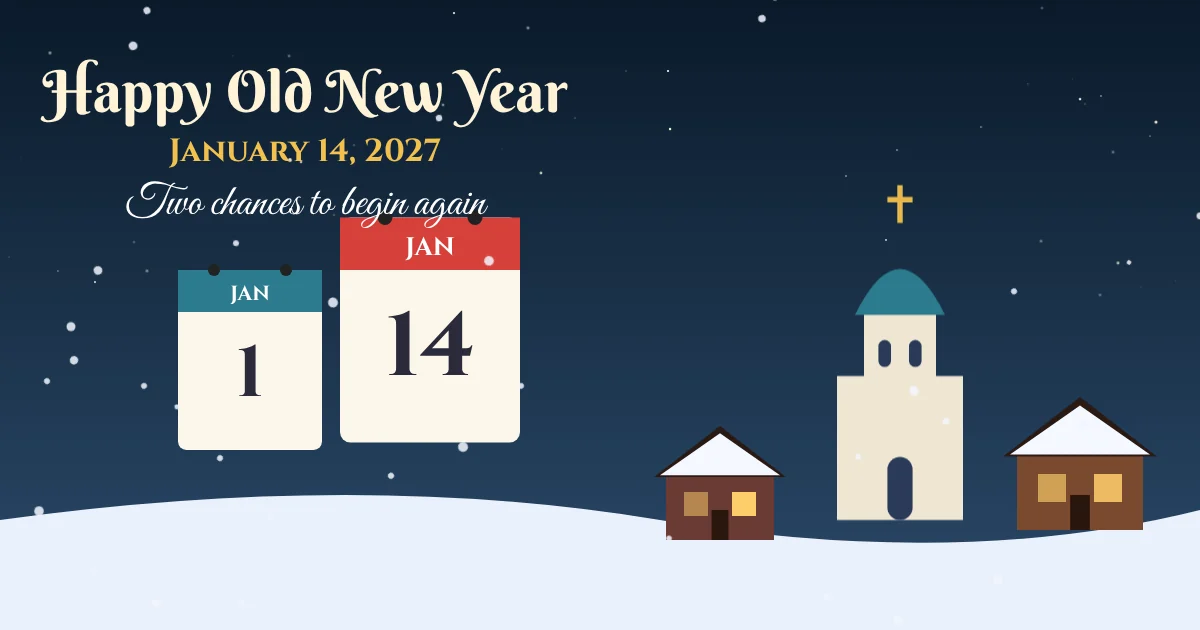
The date comes down to two calendars. The Julian calendar is older, and over centuries it drifted out of step with the seasons. The Gregorian calendar, used in most of the world today, corrected that drift. The gap between them is now 13 days, which is why January 1 on the Julian calendar lands on January 14 in the Gregorian one. Between 1901 and 2100 the Old New Year falls on January 14.
Russia, for example, used the Julian calendar until the 1917 revolution and adopted the Gregorian calendar in 1918. The Orthodox Church in many countries kept the Julian calendar for its feasts, which is why Orthodox Christmas is on January 7. The same thing happened to the new year: officially it is celebrated on January 1, but the “old” New Year on the night of January 13 to 14 remained as an unofficial, nostalgic holiday.
Where is Old New Year celebrated?
Orthodox New Year is observed in countries with large Eastern Orthodox populations, including Russia, Ukraine, Belarus, Serbia, Montenegro, North Macedonia, Georgia and Kazakhstan. It is also kept by Serb communities in Bosnia and Herzegovina, and in a few other places including parts of Switzerland, where it is known as “alter Silvester.” How it is observed varies a great deal from country to country and even family to family, so treat the traditions below as common examples rather than universal rules.
Old New Year 2027 dates
| Event | Gregorian date in 2027 |
|---|---|
| Orthodox Christmas | Thursday, January 7 |
| Old New Year’s Eve (Generous Eve) | Wednesday, January 13 (evening) |
| Old New Year (Orthodox New Year) | Thursday, January 14 |
| Feast of Saint Basil the Great | Thursday, January 14 |
Traditions: Generous Eve, Malanka and the feast table
Generous Eve
The evening of January 13 corresponds to December 31 on the Julian calendar and is known in Slavic folk tradition as Generous Eve. As the name suggests, it is a night for generosity: a full table, open doors and warm greetings. The generous evening is part of the festive stretch between Orthodox Christmas on January 7 and Old New Year on January 14.
Malanka in Ukraine
In Ukraine the Old New Year overlaps with Malanka, a carnival-like winter ritual with pre-Christian roots. The name comes from Saint Melania’s Day, which falls on December 31 on the Julian calendar. People in costumes and masks go from house to house with songs and mock plays, and the ritual’s old meaning is protection: it is a way to keep evil away in the coming year. Ukraine has since aligned many fixed religious and folk dates with the revised calendar, so Malanka is now often held earlier, beginning on December 31, in many communities.
Visits, music and good wishes
Across the Christmas week from January 7 to January 14, some families still visit homes and greet people with New Year wishes. Music and cultural festivals are common, and because the holiday falls in the dead of winter, outdoor fun suited to the cold is part of the season.
Saint Basil’s Day and the feast table
January 14 was already a special day long before the calendar reforms: Christians remember Saint Basil the Great that day. In Russian tradition the feast included pies, meat, pancakes, beer and wine, and a generous table is still the heart of the holiday today.
How to say Happy New Year in Serbian, Ukrainian and Russian
| Language | Greeting | Pronunciation guide |
|---|---|---|
| Serbian | Срећна Нова година (Srećna Nova godina) | SRETCH-na NO-va GO-di-na |
| Ukrainian | З Новим роком (Z Novym rokom) | z NO-vim RO-kom |
| Russian | С Новым годом (S Novym godom) | s NO-vim GO-dom |
Short, sincere greetings are the best way to say it. Send the greeting first in the recipient’s own language, then follow it with a personal line in English if you like.
30 original Old New Year wishes
Every message below is original. Use them as written or make them yours.
Classic Old New Year wishes
- Happy Old New Year! May the second welcome be even warmer than the first.
- Two calendars, two chances to begin again. Wishing you a bright start on January 14.
- May your table be full, your home be warm and your year be kind.
- Happy Orthodox New Year to you and your family. Peace, health and good fortune in the months ahead.
- Wishing you a generous evening and a generous year.
- May every worry from the old year stay behind in the old calendar.
- Здраво, добро и среће у новој години! (Health, goodness and happiness in the new year!)
- Wishing you a New Year that arrives gently and stays all year long.
Wishes for family
- To my family: thank you for every table you made room for me at. Happy Old New Year.
- May this year bring us more long dinners and more reasons to laugh.
- Happy Old New Year, Mom and Dad. Your kitchen is still my favorite place to begin a year.
- To my grandparents, who kept this tradition alive: we are keeping it too.
- Wherever we are on January 14, I’ll be raising a glass with you in spirit.
Wishes for friends
- Happy Old New Year, my friend. Your first January was great, and I’m hoping this one is even better.
- If one New Year isn’t enough to say thank you, here’s a second one. You mean a lot to me.
- Cheers to friends who celebrate everything twice and mean it both times.
- May the new year give you rest when you need it and joy when you least expect it.
- I’m glad to start another year with you in my life.
Wishes for couples
- Two New Years and one person I want to spend both with. Happy Old New Year, my love.
- Our year began on January 1, but it feels like it truly starts when I’m home with you on the 14th.
- Here’s to quiet evenings, warm tea and another year together.
- I’d choose either calendar as long as you’re in it.
Wishes for colleagues and neighbors
- Happy Orthodox New Year to our colleagues who celebrate. Wishing you a joyful day with your families.
- To our neighbors: may your door always open to good news. Happy Old New Year!
- Wishing you a calm, bright and productive new year, whichever calendar you follow.
- Thank you for a good year of working together. Warm wishes on January 14.
Short toasts
- To the old year, thank you. To the new year, welcome.
- To health, to home and to everyone at this table!
- To second chances and second celebrations!
- Cheers to a year as warm as this evening.
Note: wish 7 is in Serbian Cyrillic and means “health, goodness and happiness in the new year.” If you are not confident with a phrase, use the English version or ask someone who speaks the language.
Captions for social media
- Two calendars, two chances to begin.
- Midnight, once more.
- Happy Old New Year.
- A full table, a warm home, a kind year.
- Starting the year again, just a bit slower this time.
- January 14: the second New Year, and still my favorite.
Old New Year cards, GIFs and wallpaper
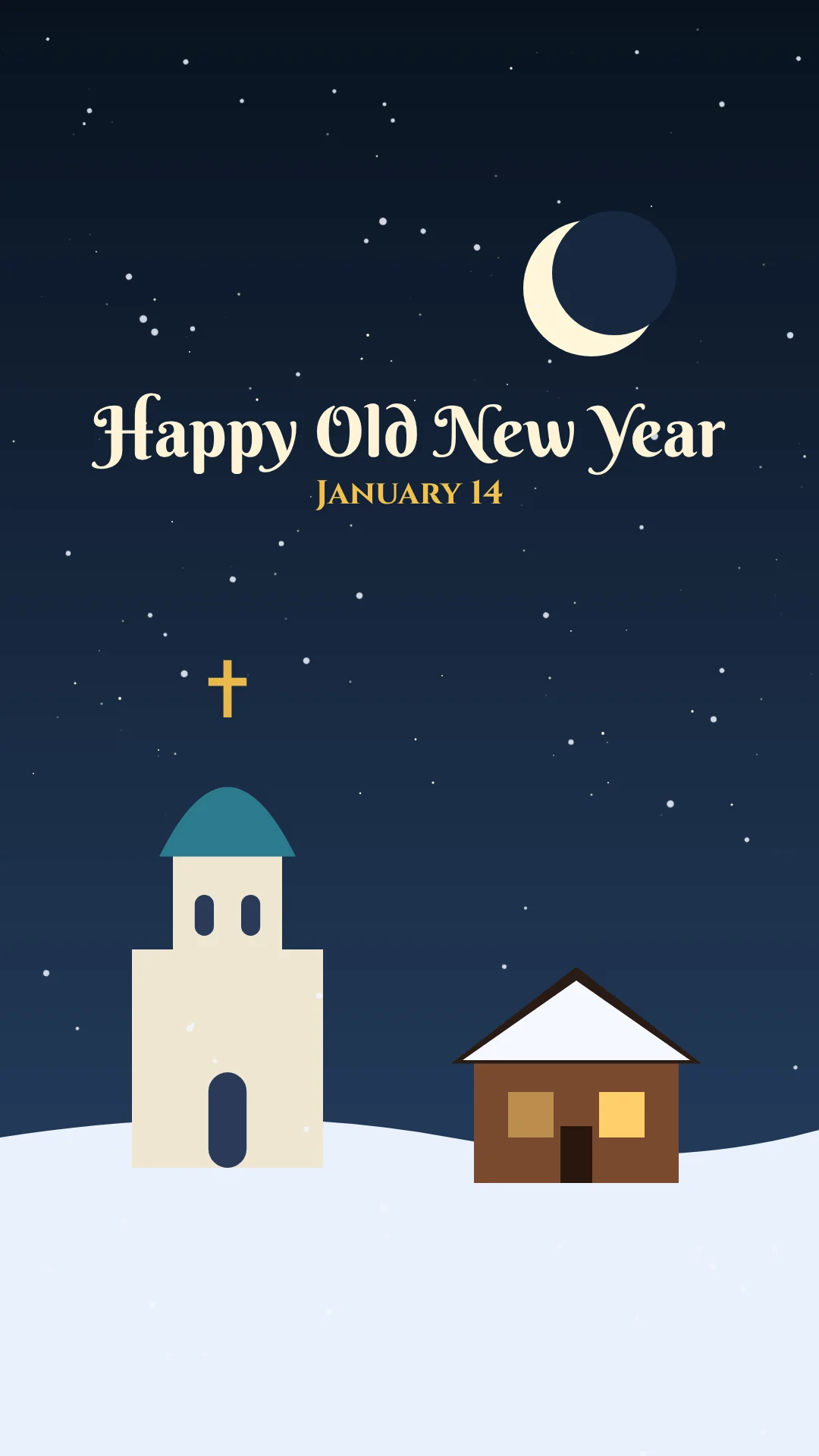
Save these and send them with your own message.
Animated GIFs
Phone wallpaper
How to celebrate Old New Year at home
- Set a generous table. Pies, pancakes, a favorite soup or a simple loaf: the point is to make enough that someone can drop by.
- Call a relative. A short call to someone who celebrates the date means more than a long group chat.
- Send a message in their language. Even a short “Z Novym rokom” or “Srećna Nova godina” shows you care.
- Light a candle. A quiet candlelit dinner suits the mood of the day.
- Share a memory. Ask older family members how they celebrated when they were young.
- Write your second resolution. If January 1 resolutions have already slipped, January 14 is a gentle reset.
More winter wishes: see our Orthodox Christmas wishes, Epiphany and Three Kings Day messages, the Hogmanay guide, New Year wishes and messages and New Year GIFs.
Frequently asked questions
When is Old New Year in 2027?
Old New Year is on Thursday, January 14, 2027. Celebrations begin on the evening of January 13.
Why is Orthodox New Year on January 14?
It is January 1 on the Julian calendar. The Julian calendar is now 13 days behind the Gregorian calendar, so that date falls on January 14.
Which countries celebrate Old New Year?
It is observed in countries with large Eastern Orthodox populations, including Russia, Ukraine, Belarus, Serbia, Montenegro, North Macedonia, Georgia and Kazakhstan. It is informal in most of them, and customs vary.
Is Old New Year a public holiday?
In most places it is an informal holiday rather than a day off. Rules differ by country and can change, so check your local government calendar.
What is Malanka?
Malanka is a Ukrainian winter folk ritual with pre-Christian roots, tied to Saint Melania’s Day. People wear costumes and masks and go from house to house with songs and skits, and the old purpose of the ritual was to keep evil away in the coming year.
What should I say on Old New Year?
Say “Happy Old New Year” or “Happy Orthodox New Year,” or use the local greeting such as “Srećna Nova godina” in Serbian or “Z Novym rokom” in Ukrainian.
A closing thought
Old New Year proves that a fresh start does not need to come only once. If January 1 went by in a blur, use January 14 to slow down: call someone, set the table, and say the good wishes you meant to say the first time. Happy Old New Year.