At the stroke of midnight, the world celebrates in a hundred different accents. In Madrid, people race to eat twelve grapes before the last chime fades. In Tokyo, temple bells ring one hundred and eight times. In Copenhagen, neighbors smash old plates against each other’s doors. And in countless homes, a phone lights up with the same message in a different language: Happy New Year.
If you have friends, family or coworkers across the world, learning how they say it makes your greeting feel personal. This guide gives you more than fifty ways to say Happy New Year, with easy pronunciation, followed by the traditions behind many of them, from lucky foods to midnight rituals. You’ll also find short bilingual messages, notes on the dates (not everyone celebrates on January 1), and tips for sending greetings that feel natural rather than copied. Latin-script spellings are used throughout so you can read them aloud and paste them straight into a card or chat.
On this page: Europe · Asia and the Pacific · Africa, Middle East and Americas · Traditions · Lucky foods · Bilingual messages · Different calendars · Tips

Happy New Year in European Languages
Many European greetings translate almost literally as “happy new year” or “good new year,” so the structure is easy to recognize. A few, like Romanian “La mulți ani,” wish the person “many years,” and the Irish and Welsh phrases use older grammar that is worth reading aloud slowly.
| Language | Greeting | How to say it |
|---|---|---|
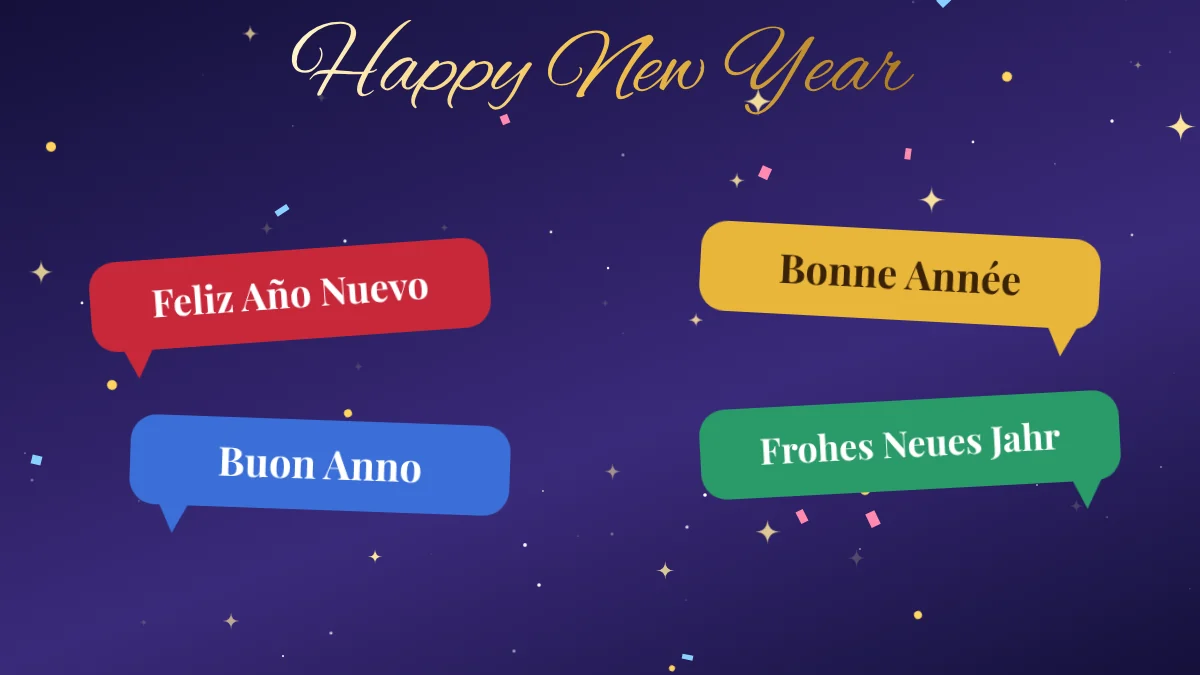
| Spanish | Feliz Año Nuevo | feh-LEEZ AHN-yo noo-EH-vo |
| French | Bonne année | bun ah-NAY |
| German | Frohes neues Jahr | FROH-es NOY-es yahr |
| Italian | Buon anno | bwon AHN-no |
| Portuguese | Feliz Ano Novo | feh-LEEZ AH-noo NO-voo |
| Dutch | Gelukkig nieuwjaar | kheh-LUK-ikh NEEW-yar |
| Swedish | Gott nytt år | got nit OR |
| Norwegian | Godt nytt år | got nit OR |
| Danish | Godt nytår | got NUT-or |
| Finnish | Hyvää uutta vuotta | HUU-vah OOT-tah VOO-ot-tah |
| Icelandic | Gleðilegt nýtt ár | GLETH-ih-lekt neet owr |
| Polish | Szczęśliwego Nowego Roku | shchen-SHLEE-veh-go no-VEH-go RO-koo |
| Czech | Šťastný nový rok | SHTYAST-nee NO-vee rok |
| Hungarian | Boldog új évet | BOL-dog OO-ee AY-vet |
| Romanian | La mulți ani | lah MOOLTS ahn |
| Greek | Eftychismenos o kainourios chronos | ef-tee-hees-MEH-nos o keh-NOO-ree-os HRO-nos |
| Irish | Athbhliain faoi mhaise | ah-VLEE-in fwee WASH-eh |
| Welsh | Blwyddyn Newydd Dda | BLOO-ith-in NEH-with thah |
| Scottish Gaelic | Bliadhna Mhath Ùr | BLEE-uh-nah vah OOR |
| Russian | S Novym Godom | s NO-vim GO-dom |
| Ukrainian | Z Novym Rokom | z NO-vim RO-kom |
| Bulgarian | Chestita Nova Godina | ches-TEE-tah NO-vah go-DEE-nah |
| Croatian | Sretna Nova godina | SRET-nah NO-vah GO-dee-nah |
| Serbian (Latin) | Srećna Nova godina | SRECH-nah NO-vah GO-dee-nah |
| Turkish | Mutlu yıllar | moot-LOO yuhl-LAR |
Many of these are easy to personalize. In Spanish-speaking countries you’ll often hear “Feliz Año Nuevo” paired with “próspero” for prosperity. In French, “Bonne année et bonne santé” adds a wish for good health, and the French traditionally exchange greetings throughout January, not just on the first day. In Germany and Austria, “Guten Rutsch!” (“a good slide”) is so common that many people say it before the year ends, and it should not be said after midnight. In Ireland and Scotland, wishes often include “slàinte,” meaning health, and in Scotland the celebration known as Hogmanay is a major festival in its own right.
Happy New Year in Asian and Pacific Languages
New Year is celebrated on different dates across Asia, so a greeting on January 1 may arrive well before the main festival. The table lists the phrases used for the January 1 celebration or the general New Year. For Chinese and Vietnamese, remember the major festival is the Lunar New Year, which falls in late January or February.
| Language | Greeting | How to say it |
|---|---|---|
| Japanese | Akemashite omedetou gozaimasu | ah-keh-mash-teh oh-meh-deh-toh go-zai-mahss |
| Mandarin Chinese | Xīnnián kuàilè | shin-nyen kwai-luh |
| Cantonese | Sān nìhn faai lohk | sahn neen fye lohk |
| Korean | Saehae bok mani badeuseyo | seh-heh bok mah-nee bah-deu-seh-yo |
| Vietnamese | Chúc mừng năm mới | chook mung nahm muh-ee |
| Thai | Sawasdee Pee Mai | sah-waht-dee pee my |
| Indonesian | Selamat Tahun Baru | seh-LAH-mat TAH-hoon BAH-roo |
| Malay | Selamat Tahun Baharu | seh-LAH-mat TAH-hoon bah-HAH-roo |
| Filipino | Manigong Bagong Taon | mah-nee-GONG bah-GONG tah-ON |
| Hindi | Naya saal mubarak | NAH-yah SAHL moo-BAH-rak |
| Bengali | Shubho Nobo Borsho | SHOO-bho NO-bo BOR-sho |
| Nepali | Naya barsa ko hardik shubhakamana | NAH-yah BAR-sah ko HAR-dik shoo-bha-KAHM-nah |
| Hawaiian | Hauʻoli Makahiki Hou | how-OH-lee mah-kah-HEE-kee HOH |
| Maori | Kia hari te Tau Hou | kee-ah HAH-ree teh tow HOH |
A quick note on Bengali: “Shubho Nobo Borsho” is most closely associated with Pohela Boishakh, the Bengali New Year on April 14, which is a public holiday in Bangladesh. On January 1, many Bangladeshis simply say “Happy New Year” in English, and young people celebrate with late-night gatherings, fireworks and messages to friends. For a general-purpose greeting, “Shubho Nobo Borsho” is warmly received at any time.

Happy New Year in African, Middle Eastern and Other Languages
| Language | Greeting | How to say it |
|---|---|---|
| Arabic | Kol ‘am wa antum bikhair | kol AHM wa AN-tum bee-KHAIR |
| Swahili | Heri ya Mwaka Mpya | HEH-ree yah MWAH-kah M-pyah |
| Afrikaans | Voorspoedige nuwe jaar | FOOR-spoo-di-kheh NEE-veh yaar |
| Zulu | Unyaka omusha omuhle | oo-NYAH-kah o-MOO-shah o-MOO-hleh |
| Yoruba | Ódún tuntun á dára | OH-doon TOON-toon ah DAH-rah |
| Esperanto | Feliĉan novan jaron | feh-LEE-chahn NO-vahn YAH-ron |
| Catalan | Feliç any nou | feh-LEES ahn NO-oo |
| Basque | Urte berri on | OOR-teh BEH-ree on |
| Maltese | Is-Sena t-Tajba | iss-SEH-nah tt-TAI-bah |
| Albanian | Gëzuar Vitin e Ri | geh-ZOO-ar VEE-tin eh REE |
Across the Arab world, New Year is celebrated in different ways. Some communities hold large public celebrations with fireworks, while others mark the Islamic New Year, which moves through the Gregorian calendar and is observed with reflection rather than parties. If you’re unsure which one your friend celebrates, “Happy New Year” with a general wish for health and happiness is always welcome.
New Year Traditions Around the World
A greeting is lovelier when you know what people actually do at midnight. These customs are widely documented, and mentioning one in a message shows that you did your homework.
Spain: twelve grapes at midnight
In Spain, people eat one grape with each of the twelve chimes of the clock on New Year’s Eve, usually while watching the countdown from the Puerta del Sol clock in Madrid. Each grape represents a month of good luck. Eating them quickly enough is part of the fun, and many people peel and seed them in advance. The tradition has spread to Latin America and Portugal.
United States: the Times Square ball
The ball drop in New York’s Times Square has taken place since 1907, and the crowd gathers in the cold for hours to watch the final countdown. Many Americans watch from home with sparkling drinks and a kiss at midnight. If you are in the United States, you can pair the greeting with our New Year’s Eve images and wishes.
Japan: Joya no Kane and osechi
At Buddhist temples across Japan, bells are rung 108 times at the end of the year, a ritual called Joya no Kane. The number is linked to the 108 earthly desires in Buddhist belief, and each ring is meant to clear one of them. The next day, families eat osechi ryori, a set of colorful dishes packed in tiered boxes, with each food carrying a meaning, such as health, happiness or long life. Cards called nengajo are mailed so that they arrive on January 1.
Denmark: smashing plates
Danish families save old dishes throughout the year and throw them at the doors of friends and neighbors on New Year’s Eve. A big pile of broken china on your doorstep is a sign that you are well loved. People also climb on chairs and jump into the new year at midnight.
Scotland: first-footing
The first person to cross your threshold after midnight is the “first-foot,” and tradition says they should bring gifts such as coal, shortbread and a drop of whisky to bring luck. A tall, dark-haired visitor is traditionally considered the luckiest. Learn more in our guide to Hogmanay wishes and Scottish New Year traditions.
Colombia and Ecuador: suitcases and scarecrows
In Colombia, people who hope to travel in the coming year run around the block with an empty suitcase at midnight. In Ecuador, families build effigies called años viejos, stuffed with paper and old clothes, and burn them at midnight to leave the old year behind.
Brazil: white clothes and seven waves
Many Brazilians wear white for peace on New Year’s Eve and gather on beaches such as Copacabana. At midnight, they jump over seven waves and make a wish with each one, an offering associated with Iemanjá, the goddess of the sea. Flowers are often thrown into the water.
The Philippines: round things for prosperity
Round shapes symbolize coins and wealth, so Filipino families put out twelve round fruits, wear polka dots and make noise with horns and pots to scare away bad luck. Many also jump at midnight in the belief that it will help children grow taller.
Greece: vasilopita
On New Year’s Day, Greek families cut a vasilopita, a cake with a coin baked inside. The first slice is for Saint Basil, then slices are served by age or role, and whoever finds the coin is believed to have good luck for the year.
Estonia: eating seven, nine or twelve times
Estonians traditionally eat seven, nine or twelve meals on New Year’s Day, since each is believed to give the strength of that many people in the coming year. Leaving a little food on the table for the spirits of ancestors is also customary in some families.
Germany: Bleigießen and fireworks
Traditionally, Germans melted small pieces of lead and poured them into cold water to predict the future from the shapes. Because of safety concerns, many households now use wax or tin. Fireworks and “Dinner for One,” a British comedy sketch that has become a New Year’s Eve fixture on German television, are also part of the night.
For more on specific celebrations, see our guides to New Year’s Day wishes for 2027 and Old New Year and the Orthodox New Year.
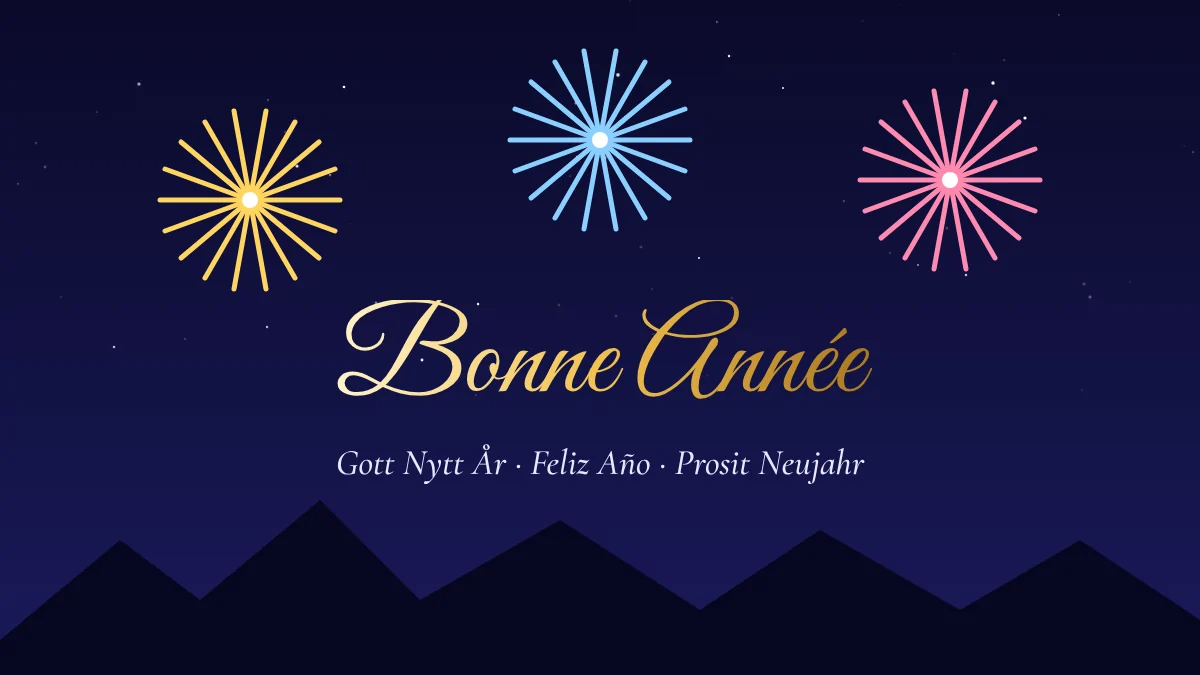
Lucky New Year Foods
Food is central to New Year luck in many cultures. If you’re hosting a mixed crowd, serving one of these will start good conversations.
- Grapes (Spain, Latin America): twelve for twelve months of luck.
- Lentils (Italy, Brazil): small coins that stand for wealth. Italians often eat lentils with cotechino sausage.
- Black-eyed peas and greens (southern United States): peas for coins, greens for paper money.
- Soba noodles (Japan): long noodles for a long life, eaten on New Year’s Eve as toshikoshi soba.
- Pomegranates (Greece, Turkey): seeds for abundance.
- Round fruits (Philippines): shaped like coins.
- Pork (Austria, Germany, Cuba): a symbol of progress, since pigs push forward as they root.
- Herring (Poland, Scandinavia): a symbol of abundance.
- Vasilopita (Greece): a cake with a hidden coin.
- Cake rings and pastries (Netherlands): oliebollen, deep-fried dough balls, are an essential New Year’s Eve treat.
Short Bilingual New Year Messages
These simple messages pair a greeting in another language with a short English line. Use them in cards, social posts and group chats.
- Feliz Año Nuevo! May your year be full of good surprises.
- Bonne année! Wishing you health, laughter and plenty of cheese.
- Frohes neues Jahr! May the new year slide in smoothly.
- Buon anno! May your plate always be full and your table full of friends.
- Feliz Ano Novo! Here’s to sunshine, music and new beginnings.
- Gott nytt år! May the new year be bright, even in winter.
- Szczęśliwego Nowego Roku! Wishing you happiness in every month.
- Akemashite omedetou gozaimasu! May the year ahead bring peace and good fortune.
- Xīnnián kuàilè! Wishing you a new year filled with luck.
- Selamat Tahun Baru! May your hopes come true in the new year.
- Manigong Bagong Taon! Here’s to prosperity and family time.
- Naya saal mubarak! May your new year be filled with joy and success.
- Heri ya Mwaka Mpya! Wishing you peace and good health.
- Athbhliain faoi mhaise! May your year be prosperous and kind.
- La mulți ani! Many years of health and happiness.
- Gleðilegt nýtt ár! May your new year glow like the northern lights.
For longer messages in English, you’ll find plenty in our best Happy New Year wishes and greetings, New Year wishes and SMS messages and New Year wishes for friends.
When Different Cultures Celebrate the New Year
Not everyone’s year begins on January 1. Checking the date before you send a greeting is thoughtful, and it often leads to a friendly conversation.
- January 1: the Gregorian New Year, observed in most countries.
- January 14: Old New Year in some Orthodox communities, as explained in our Old New Year guide.
- Late January to mid-February: Lunar New Year, celebrated in China, Vietnam (Tết), Korea (Seollal) and elsewhere. See our guide to Lunar New Year wishes.
- March 20 or 21: Nowruz, the Persian New Year, celebrated in Iran, Afghanistan, Central Asia and parts of the Caucasus.
- April 13 to 15: New Year in many South and Southeast Asian calendars, including Pohela Boishakh in Bangladesh and Songkran in Thailand.
- September or October: Rosh Hashanah, the Jewish New Year, which follows the Hebrew calendar.
- Varies: Islamic New Year, which shifts through the Gregorian calendar each year.
How to Reply to a New Year Greeting in Other Languages
When someone sends you a greeting, a quick reply in kind is a lovely touch. Here are common responses that work in everyday conversation.
- Spanish: “Igualmente” (likewise) or “Feliz Año Nuevo para ti también” (Happy New Year to you too).
- French: “À vous aussi” (to you as well, formal) or “À toi aussi” (informal).
- German: “Danke, gleichfalls” (thanks, same to you) or “Ebenfalls!”
- Italian: “Altrettanto” (likewise) or “Grazie, anche a te.”
- Portuguese: “Igualmente” or “Para você também.”
- Dutch: “Jij ook!” (you too).
- Swedish: “Detsamma” (the same to you).
- Polish: “Wzajemnie” (likewise).
- Japanese: “Kotoshi mo yoroshiku onegaishimasu” (please treat me kindly again this year), a common reply and wish for continued friendship.
- Indonesian: “Sama-sama” (the same to you).
- Tagalog: “Salamat, ganoon din sa iyo” (thanks, the same to you).
Fun Facts About New Year Celebrations
- Many cultures believe that what you do on the first day sets the tone for the whole year, which is why people clean, pay debts or wear special colors.
- Auld Lang Syne, based on a poem by Robert Burns, is sung in many English-speaking countries at midnight, and similar songs are used in other languages.
- Fireworks, bells and loud noises are used in many cultures to scare away evil spirits and welcome the new year with a bang.
- Midnight kisses are a long-standing tradition in the United States and parts of Europe, said to bring luck and affection for the year ahead.
- Time zones mean the new year arrives first in the Pacific and last in parts of the Americas, so celebrations roll around the globe for about a full day.
Business New Year Greetings in Other Languages
For clients and colleagues abroad, a formal greeting with a wish for the coming year is a respectful touch. These formal lines are widely understood.
- Spanish: “Le deseamos un feliz y próspero Año Nuevo.” (We wish you a happy and prosperous New Year.)
- French: “Nous vous souhaitons une excellente année.” (We wish you an excellent year.)
- German: “Wir wünschen Ihnen ein erfolgreiches neues Jahr.” (We wish you a successful new year.)
- Italian: “Tanti auguri di buon anno a lei e alla sua azienda.” (Best wishes for the new year to you and your company.)
- Portuguese: “Desejamos-lhe um excelente Ano Novo.” (We wish you an excellent New Year.)
Tips for Sending a New Year Greeting in Another Language
- Check the spelling and accents. Letters like ñ, ü, å and ś change how a word looks and sounds.
- Keep it short. A standard greeting is more respectful than a poorly translated paragraph.
- Add an English line. A short personal sentence in English helps if you aren’t sure about the other language.
- Match the date. Send it at the right time for their calendar.
- Add an image. A bright card or a GIF turns a simple text into a celebration. Our Happy New Year GIFs and images are ready to share.
- Consider time zones. If you want your message to arrive at midnight, remember that the new year arrives first in the Pacific and last in the Americas.
- Ask a native speaker for big occasions. If you’re writing a business greeting, a quick check helps.
Conclusion
Whether it’s grapes in Madrid, bells in Kyoto or a pile of broken plates in Denmark, every culture marks the turning of the year with hope. A few words in someone’s own language, a short note and a bright card are all you need to join in. Save your favorite greetings from this list, check which calendar your friend follows and send your message with a smile. Looking ahead to the celebration itself? Our guides to New Year captions, common New Year’s resolutions and New Year’s Day wishes for 2027 will help you plan. Happy New Year, in every language.